The University of Manchester

A study produced when the ATLAS was developed concluded that five of them would satisfy all the country’s scientific computer requirements!


...Past, Present and Future

Manchester’s continuing presence at the forefront of computing innovation is a catalogue of firsts, thanks to The University of Manchester, Ferranti, ICT and subsequently ICL at West Gorton.

  • In 1951, Ferranti delivered the first commercial stored-program computer, the Mark I, based on the University design
  • In the 1950s, MERCURY Autocode was developed, the world’s first true user interface specifically designed for scientific users rather than programmers
  • The University of Manchester developed the first floating point machine, and later, the first transistor computer
  • NEBULA was developed, a brilliantly innovative business user’s language
  • The ATLAS machine of the 1960s pioneered virtual memory, and was regarded as the fastest computer in the world
  • In 1964, Ferranti’s ARGUS machine was the keystone to the successful development of the first direct digital control of a complete plant
  • In 1974, the MU5 was developed by the University with grants from Government and ICL. It introduced an innovative architecture similar to the one used by ICL for its successful 2900 series machines

ICL

At its site in West Gorton, ICL boasts one of the largest installations of commercial computing power under one roof anywhere in Europe.


The inauguration of ATLAS,
the world's first virtual memory
machine, at the University in 1962
  
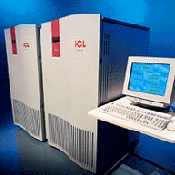
ICL Series 39 SX, the world's most
powerful mainframe when it was launched in 1991

From the 1960s onwards, the outstandingly successful ICL1904 and 1905 were launched. Variants of these machines, including the ICL 2903 and 2904 developed in the 1970s, have seen many customers through to the 1990s.


AMULET chip, the most powerful
machine ever designed at
The University
  
Trimetra, ICL West Gorton's latest range
of Large Computer Systems
Right from the outset, Manchester was recognised as a place where the new technologies could forge ahead:
  • In 1946 the Royal Society gave a grant to M.H.A. Newman (earlier in charge of, for example, Colossus, the wartime code breaker) to establish the Royal Society Computer Laboratory, at The University of Manchester
  • In 1956 Ferranti established computing at the West Gorton site
  • In 1964 the Department of Computer Science was founded at The University of Manchester. It has achieved grade 5 in all HEFCE research assessment exercises
  • In 1981, ICL Mainframe Systems, West Gorton, signed the inaugural technology collaboration agreement with Fujitsu Ltd of Japan
  • The Department of Computer Science leads the world in the development of asynchronous microprocessors. In 1996 it developed the AMULET2 microchip. This is a single integrated circuit, operating asynchronously, and is by far the most powerful, and smallest, computer designed at the University
  • The Department has on-going research projects in CAD, Artificial Intelligence, and Formal Methods, as well as leading-edge work in digital technology, hardware systems engineering, computer architecture and systems software
  • ICL has an advanced, high technology computing development centre comparable with anything available to the computer industry world-wide. In recent years it has won three ‘Queen’s Awards for Technological
  • Achievement’, two ‘Mainframe of the Year’ awards, and was outright winner of the United Kingdom Quality
  • Award for Business Excellence in 1995.

Manchester was, is and will continue to be a ground-breaking, exciting place leading the way in the world-wide revolution that is computing today.

PreviousHome of ComputingNext